
There’s hardly a space across any app and social feed that doesn’t have an AI function or at least talking about it. There’s hardly a presentation or conversation where it’s not mentioned.
Interestingly – and not at all surprising in today’s environment – it has been the creative industries that have been put on notice. But is it at humanity’s expense?
Looking back not so long ago it was our ‘tradies’ – builders, machinery operators, electricians, the list goes on – who were concerned that AI and robots would take over their jobs. There are certainly some aspects that have been taken over by remote operations. Take Rio Tinto for example, who back in 2015 had more than 60 remotely operated trucks across its mines in Western Australia, with that number growing to over 130 today.
Whilst it is just the beginning, there is still a long way to go in the building, construction and mining industries before the trades are put out of work. (Let’s be honest, the tradies are in their absolute hey-day, in higher demand than ever before.)
We’re quick to forget that the very basics of AI is a series of ones and zeros, ons and offs. At risk of sounding poetic and even a little biblical, AI has been developed in the image of humans and generates upon a series of rules and customs that we have created. (Full respect to those scientists who developed and continue to develop our technologies.)
At risk of sounding poetic and even a little biblical, AI has been developed in the image of humans and generates upon a series of rules and customs that we have created.
But what AI doesn’t possess is emotion. It doesn’t craft with love. A facts and figures article that AI creates on economies and the stock market might be on point. It can create a sonnet likened to Shakespeare. It can extend the scene of Van Gogh’s Starry Night at the click of a button. AI’s craft is analysis of human input. But what it lacks is the enrichment of human emotion.
In the masterpieces of literature, art and music that we connective with, we wonder what the artist meant and what they were feeling. Were they in love? Were they angry? Were they sad? Were they heartbroken? Was it about a certain person? The world even speculates the breakups and heartache with every Taylor Swift album drop. It’s these questions and intrigue that capture us and swim around our psyche.
As AI develops and the need for creatives disappears, in ten years will we be seeking connection to the chatbot that becomes the world’s biggest popstar? Will we be pondering the tale of how it fell in love and then wrote an incredible love song? Will it win a Grammy?
Seems a little far-fetched, right?
Take a look at home cooking and innovation in the food industry driven from industrialism, mass production and food sciences. From Betty Crocker cake mixes to Two Minute Noodles, partially roasted pork conveniently packaged with coleslaw and tortillas. Sure, it’s easy and tastes okay. But the robot that packs it or the person that heats it isn’t a chef. It doesn’t take away from a chef’s organic craft, blending tastes and textures for the ultimate culinary experience.
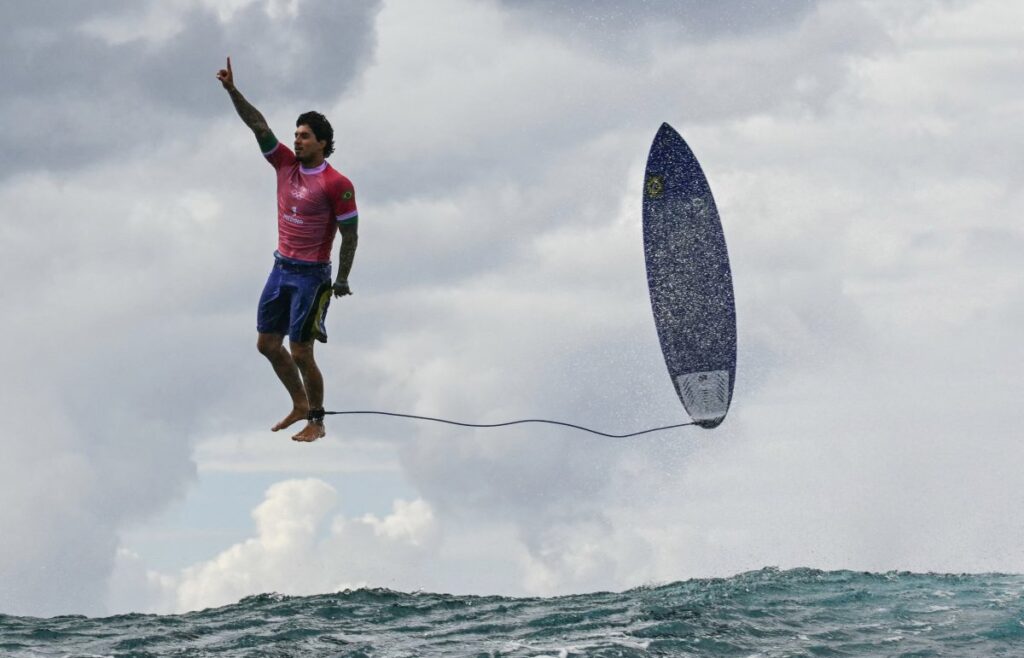
AI can craft an article or a social media post for you, and sure it’s ok. It might even add a few emojis to tap into certain audiences. You could ask AI to create an image of a surfer leaping out the water in parallel to the surfboard, but it doesn’t remove the magic when exactly that is captured by photographer Jerome Brouillet in Tahiti of Gabriel Medina in the Olympic surfing heats.
We have the means to drive cars, ride in planes, fly in rockets and yet one of the most highly watched and anticipated Olympic events is the 100m sprint – showing that we still crave watching and understanding how we push our bodies to the limit.
We continue to celebrate the humans who are the strongest and fastest, the humans with creative and intellectual genius.
Our lives might be a little easier. Things may become more convenient. But it doesn’t stop the connection we have to each other.
Last year I asked Alex Jenkins, the Director of the WA Data Science Innovation Hub, what did he foresee would happen in the world of AI and robotics in the next 10 to 15 years? The answer was along the lines of that it’s the great unknown, but the one thing that is certain is that AI is moving at lightning speed.
So, embrace it, it’s here to stay. But always remember that there is still a yearning for human creativity and ability. Let’s not forget our humanity.